

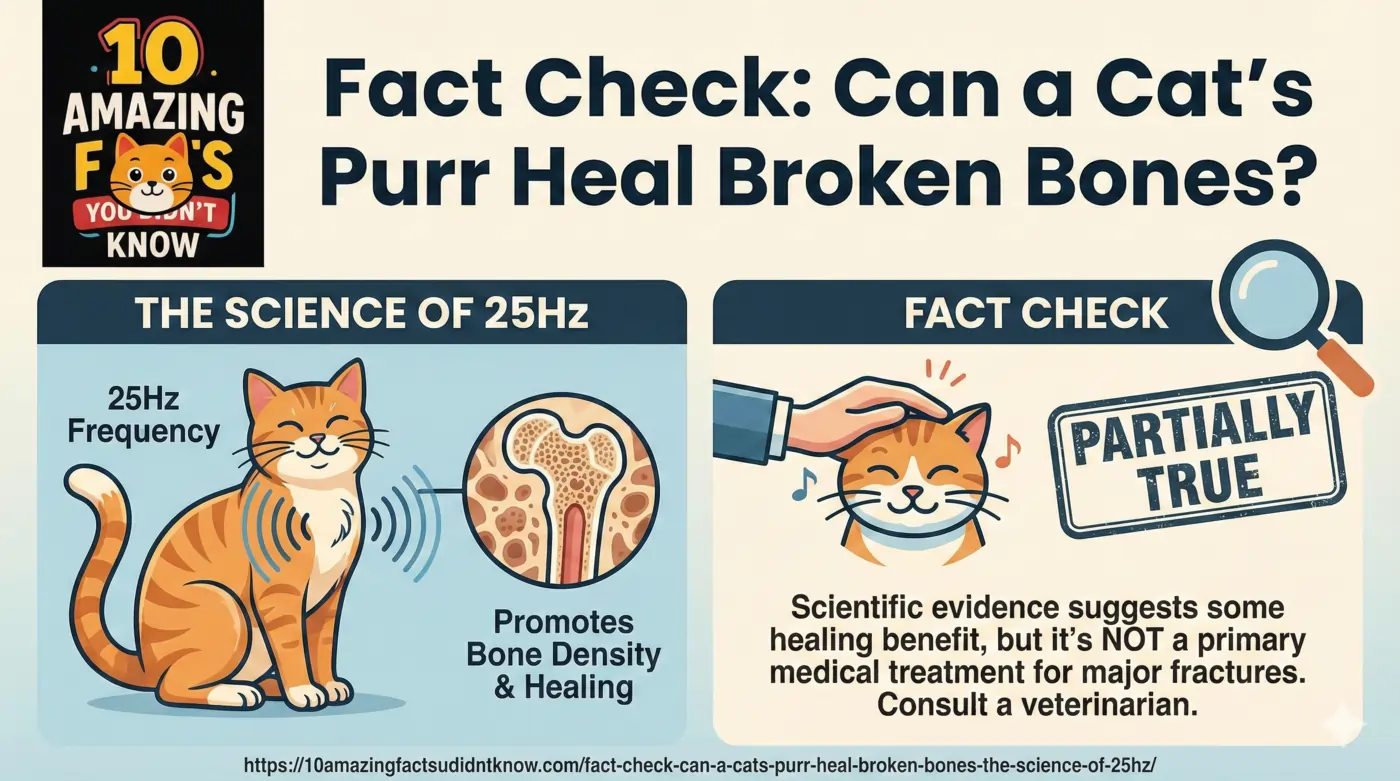
Fact Check: Can a Cat’s Purr Heal Broken Bones?
Fact Check: Can a Cat’s Purr Heal Broken Bones? (The Science of 25Hz)
Cat-s purr can help to heal using their frequencies, they position exactly where the issue is and starts to purr, and they do it so they can help you in the healing process.
There is an old saying among veterinarians: “If you put a cat and a bunch of broken bones in the same room, the bones will heal.”
For decades, we thought this was just a cute observation about how tough cats are. We know cats always land on their feet. We know they seem to recover from surgery faster than dogs. But we assumed the purr was just a sound—a noise they made when they were happy.
We were wrong.
Recent bio-acoustic research suggests that a cat’s purr isn’t just communication. It’s a bio-mechanical healing mechanism. Specifically, it functions like a high-tech medical device used by physical therapists and astronauts to fix bone density issues.
Here is the science behind why your cat might be the fluffiest doctor in the house.
The Magic Number: 25 Hertz
To understand how a purr works, you have to look at frequency.
Everything that vibrates has a frequency measured in Hertz (Hz). When scientists analyzed the purr of the domestic cat (Felis catus), they found something strange. The purr doesn’t just rumble randomly. It consistently hits a frequency range between 25 Hz and 150 Hz.
Why does that number matter?
Because 25 Hz is the “goldilocks” frequency for bone growth.
Research from the Fauna Communications Research Institute indicates that frequencies between 20 Hz and 50 Hz help speed up the healing of bone fractures. When a bone is subjected to this specific vibration, it triggers osteoblasts—the cells responsible for building new bone tissue—to work harder.
NASA and the “Purr” Technology
This isn’t just theory; we use this technology on humans right now. It’s called Whole Body Vibration (WBV) therapy.
When astronauts go to space, the lack of gravity causes their bones to weaken (osteoporosis). To stop their bones from turning to dust, NASA and space agencies experimented with vibration plates that hum at low frequencies to trick the bones into thinking they are under stress, causing them to strengthen.
The frequencies they use often overlap exactly with your cat’s purr.
-
25 Hz to 50 Hz: Best for strengthening broken bones.
-
100 Hz to 140 Hz: Best for healing soft tissue and reducing swelling.
Your cat is essentially a walking, purring vibration therapy plate.
The “Survival Mechanism” Theory
This science also explains a mystery that has puzzled biologists for years: Why do cats purr when they are hurt?
Most people think cats only purr when they are happy. But vets will tell you that cats also purr when they are terrified, in pain, or even dying. If a purr was just a smile, this wouldn’t make sense.
However, if the purr is a healing tool, it makes perfect sense.
When a cat is injured in the wild, it can’t limp to a hospital. It finds a safe hole, curls up, and purrs. The vibration helps reduce pain, keeps their muscles from atrophying while they rest, and stimulates their bones to knit back together. It is an internal survival mechanism that allows them to recover from falls and fights that would kill other animals.
The Verdict: Can Your Cat Fix Your Broken Leg?
So, if you break your arm, should you skip the hospital and just tape a kitten to your cast?
No. (Please go to the doctor).
While the science is real, the intensity is the difference. Medical devices deliver these vibrations at high power directly to the injury. A cat’s purr is gentle. While a cat sleeping on your chest may technically speed up healing and lower your blood pressure (which also aids recovery), it is not a replacement for a cast or surgery.
However, the evidence suggests that the “crazy cat lady” with 10 cats might be onto something. Living in an environment filled with these therapeutic vibrations—essentially a “purr bath”—may contribute to better bone density and lower stress over a lifetime.
Summary of the Facts
-
Frequency: Domestic cats purr at 25Hz to 150Hz.
-
Medical Use: Frequencies of 20-50Hz are medically proven to accelerate bone fracture healing.
-
Application: This is the same principle behind vibration therapy used for astronauts.
-
Conclusion: Fact. A cat’s purr possesses the correct physical properties to aid healing, even if it works slower than a hospital machine.