

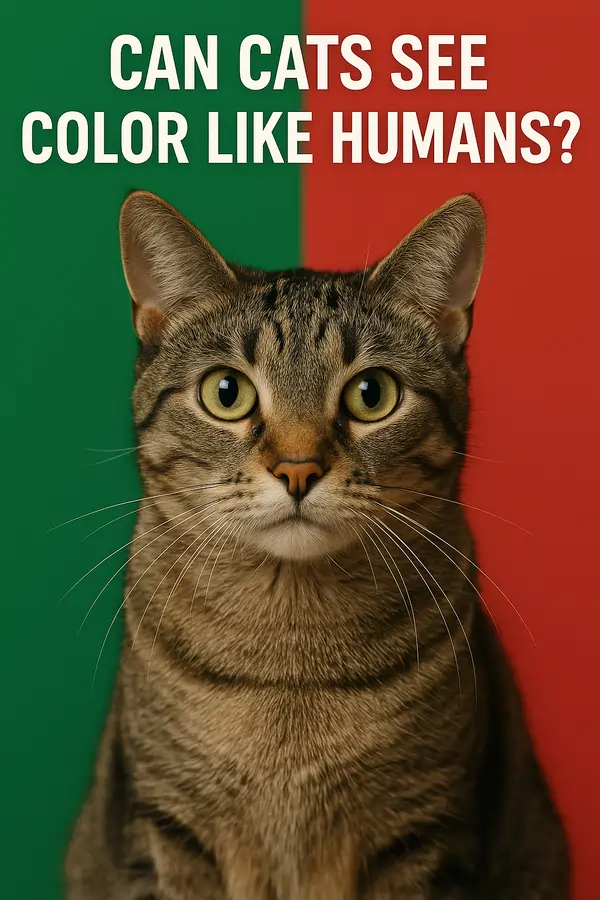
Can cats see color like human?
🐾 Can Cats See Color Like Humans? The Truth About How Felines See the World
Have you ever wondered what your cat actually sees when they watch the red dot from a laser pointer, or when they stare out the window at a colorful bird? Many cat owners assume their feline friends live in a gray, colorless world — but that’s not entirely true. In fact, cats do see color, just not the same way humans do.
Let’s take a closer look at how your cat perceives the world — and why understanding this can actually help you bond with your furry friend in surprising ways.
🌈 Do Cats Really See in Color?
Contrary to the long-held belief that cats are completely color blind, science says otherwise. Research from Cornell University’s College of Veterinary Medicine and PetMD shows that cats can distinguish certain colors — mainly blues and greens.
Humans have three types of color-detecting cells in the retina called cones, which allow us to see a wide spectrum of color. Cats, on the other hand, only have two types of cones. This means their color vision is somewhat like a person who is red-green colorblind.
They can likely see:
-
Blues and violets (clearly)
-
Greens and yellows (fairly well)
-
Reds and pinks (not very well — they often appear gray or brownish)
In other words, your cat doesn’t see the world in dull black and white — they simply see it in a softer, cooler palette.
👁️ Cat Vision vs. Human Vision: What’s the Difference?
Imagine putting on a pair of sunglasses that slightly dim the world and soften its colors — that’s how cats see compared to humans.
Humans have evolved for daylight vision, while cats have evolved for dawn and dusk hunting. Their eyes are designed to detect motion in low light, not to appreciate the full rainbow of colors.
Here’s a quick breakdown:
| Feature | Humans | Cats |
|---|---|---|
| Color Range | Full spectrum (red, green, blue) | Limited (blue, green) |
| Night Vision | Weak | Excellent |
| Motion Detection | Good | Exceptional |
| Peripheral Vision | ~180° | ~200° |
| Focus Detail | High | Moderate |
According to The American Society for the Prevention of Cruelty to Animals (ASPCA), cats’ retinas contain more rod cells (which detect light and movement) than cone cells. This gives them a serious advantage in seeing things move — even in near-darkness.
So the next time you see your cat chase something invisible to you? They’re not imagining it — they’re simply seeing movement in ways you can’t.
🌙 Why Cats See Better in the Dark
Cats are crepuscular creatures, meaning they’re most active at dawn and dusk. Their eyes have a special reflective layer behind the retina called the tapetum lucidum, which acts like a mirror to bounce light back through the eye — allowing them to see in conditions up to six times dimmer than what a human eye could handle.
This is also why your cat’s eyes glow eerily in the dark when a flashlight hits them — it’s the tapetum at work.
In short, cats trade off color accuracy for the superpower of night vision.
🧠 How This Impacts Their Behavior
Your cat’s unique vision explains a lot of their quirky habits. For example:
-
Why cats love chasing moving objects – Their eyes are wired for detecting motion, not fine detail.
-
Why they don’t always respond to red toys – Reds and pinks may look dull or gray to them.
-
Why they stare out the window for hours – Even distant movement, like a leaf fluttering, catches their eye instantly.
By understanding your cat’s vision, you can actually choose better toys and create a more enriching environment. Try toys that are blue or green — they’ll stand out better in your cat’s world.
🎥 See the World Through a Cat’s Eyes
If you’re fascinated by this topic, you’ll love the visual comparisons and real-life experiments we’ve featured in our latest videos on 10 Amazing Facts You Didn’t Know YouTube Channel.
You’ll get to see side-by-side visuals of how humans and cats perceive color — it’s mind-blowing!
👉 Don’t miss out — subscribe to our YouTube channel and join our growing community of curious animal lovers. Every week, we share fascinating facts that change the way you see the world around you.
💡 Real Research: What Science Says About Cat Color Vision
One of the most cited studies on feline vision, published in the Journal of Physiology, confirms that cats’ two types of cone photoreceptors make them dichromatic, not monochromatic. They see the world somewhat like humans with deuteranopia, a type of color blindness.
However, scientists are still discovering nuances. New research suggests cats might perceive more color than we previously thought — possibly detecting subtle shades between blue and green, though not vivid reds or oranges.
As PetMD explains, while color isn’t their strongest sense, cats’ ability to interpret light, distance, and motion gives them near-supernatural hunting precision.
🐈 What This Means for You and Your Cat
Understanding your cat’s visual world can actually improve your bond. When you realize your cat doesn’t see the bright red toy you’re dangling, you can switch to a color that pops in their visual range — like blue or green — making playtime more fun and engaging.
And when your cat seems fascinated by something invisible, remember — they might be spotting the subtlest motion, something that your human eyes can’t detect.
❤️ Stay Curious With Us
At 10 Amazing Facts You Didn’t Know, we believe the world is full of hidden wonders — especially when seen through the eyes of our animal companions.
If you enjoy uncovering fascinating truths like this one, consider joining our premium members’ community for exclusive deep-dive articles, videos, and behind-the-scenes discoveries that you won’t find anywhere else.
Your subscription helps support independent, educational content — and unlocks access to hundreds of mind-blowing facts that will keep you curious every day.
👉 Become part of our amazing facts family today!
❓ Frequently Asked Questions
1. Can cats see color like humans?
No. Cats see fewer colors than humans. While we see the full spectrum, cats mainly perceive shades of blue and green, while reds and pinks appear muted or grayish.
2. Are cats color blind?
Not entirely. Cats are dichromatic, meaning they see two primary color ranges instead of three. It’s similar to how a color-blind person sees the world.
3. What colors do cats see best?
Cats see blues, violets, and greens most vividly. Bright red toys may not stand out to them at all.
4. Can cats see in the dark?
Yes! Cats can see in light levels six times dimmer than humans, thanks to their tapetum lucidum and rod-rich retinas.
5. Why do my cat’s eyes glow in the dark?
That glowing effect comes from the tapetum lucidum, a reflective layer that enhances night vision by bouncing light back through the retina.
6. How can I make playtime more fun for my cat?
Choose toys in blue and green hues, and add motion. Cats are drawn to movement and contrast more than color itself.
7. Do cats see screens or videos?
Yes — though not as sharply as humans. They recognize motion and color contrasts, which is why many cats love watching videos designed for them (try one on our YouTube channel!).
Curiosity doesn’t stop here! 🐾
👉 Explore more fascinating facts on 10AmazingFactsUDidntKnow.com and subscribe to our YouTube channel to see the world from a whole new perspective.