
Are Black Cats Bad Luck? Myths, Facts, and Surprising Truths
Are Black Cats Bad Luck? The Truth Behind the Superstition
Introduction: Why This Question Still Haunts Us
Hi, I am 10 Amazing Facts You didnt Know, Author of this article, and i am going to give you my personal perception as owner of a black cat called munci. They are not bad luck at all, all the contrary they are really smart, playfull and loving little tigers, that can be considered between the smartest in the animal kingdom. If you give them love they can even say words like mama, yes, cold, and some others they try to mimick the words so they can communicate with you and are really smart. Now there is scientific evidence that supports what i am saying that they are not bad luck, i present to you this evidence next:
One study shows that black cats are less likely to be adopted due to superstition ASPCA. For more historical context on black cat myths, see this National Geographic article.
Scientific / Academic Studies & Papers
“Black Cat Bias: Prevalence and Predictors” (Jones & Hart)
A psychological study that shows people tend to view black cats more negatively (less friendly, less adoptable) and that this bias is correlated with superstition (but not religiosity or racial prejudice) Reference PubMed
-
-
Full PDF available via Gwern: “Black Cat Bias” Gwern
-
Black Cats are definitely not bad luck. They are specially smart and really caring, they are like little babies in a form of a cat. Really loyal, they can feel your emotions and be with you and they will heal you and your home by cleaning all your spaces taking out the bad energy and transforming the spaces in to a clean ambience. I realy think they are really special and good companions.
“Are black cats bad luck?” It’s a question whispered at Halloween parties, debated in living rooms, and even influencing adoption rates at animal shelters. For centuries, these mysterious creatures have been tied to myths of witchcraft, omens, and superstition. But is there any truth behind the fear, or is it time to finally set the record straight?
At 10 Amazing Facts You Didn’t Know, we dig deeper into the stories behind popular myths, revealing what history, science, and culture actually say. By the end of this article, you’ll not only know whether black cats are unlucky—you’ll see them in an entirely new light. And if you love exploring surprising truths like this one, make sure to subscribe to our site for exclusive deep dives and member-only content that goes far beyond what you’ll find for free online.
The Origins of the Black Cat Superstition
The superstition surrounding black cats didn’t appear out of nowhere. Historians trace it back to the Middle Ages in Europe, when fear of witchcraft was at its peak. During this time, anything mysterious or hard to explain was often linked to dark magic. Black cats, with their sleek coats and ability to blend into the night, became easy targets for suspicion. Some people even believed that witches could transform into black cats to move around unnoticed, or that the animals themselves served as their companions and messengers. Over the centuries, these fears took root in folklore, passing from one generation to the next and eventually shaping the unlucky reputation black cats still carry in some cultures today. A soruce that backs this up is Encyclopaedia Britannica — “Why Are Black Cats Unlucky?” (gives a concise historical summary linking the idea to witchcraft and early modern witch trials). Encyclopedia Britannica
-
In 1233, Pope Gregory IX declared black cats linked to the devil, fueling widespread fear.
-
Villagers believed witches could transform into black cats at night to roam unseen.
-
As a result, many black cats were killed during witch hunts, and their reputation as unlucky animals grew stronger.
Ironically, this superstition made plagues worse. Cats were natural rat hunters, but when populations of cats were destroyed, rat numbers soared—spreading the Black Death across Europe. In a cruel twist of fate, labeling cats as “bad luck” may have cost millions of human lives.
Black Cats as Symbols of Good Fortune
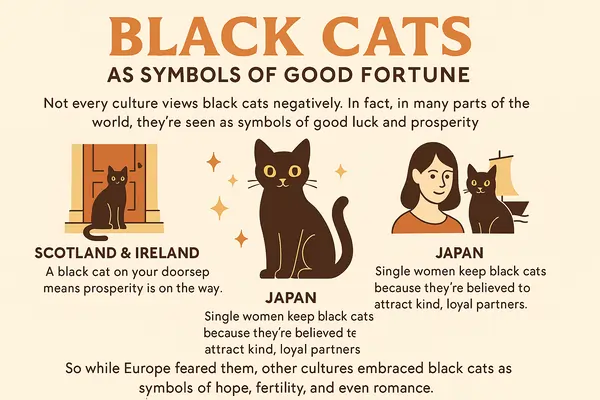
Not every culture views black cats negatively. In fact, in many parts of the world, they’re seen as symbols of good luck and prosperity. For example, in Japan, owning a black cat is thought to bring fortune and protect against evil spirits. Similarly, in parts of the United Kingdom, black cats crossing your path are considered a positive omen, especially for newlyweds or those starting a new venture. These contrasting beliefs show how cultural context shapes whether black cats are feared, admired, or celebrated. This article support this claims: “Four Paws — “Black Cat Myths and Facts”
-
Scotland & Ireland: A black cat on your doorstep means prosperity is on the way.
-
Japan: Single women keep black cats because they’re believed to attract kind, loyal partners.
-
Sailors & Fishermen: Black cats were prized aboard ships because they were thought to protect sailors from storms and ensure a safe return home.
So while Europe feared them, other cultures embraced black cats as symbols of hope, fertility, and even romance. Honestly, Black cats are not bad luck at all, they were just in the wrong place at determined time in history, beside smart women who believe in healing with plants and other knowledge that were considered bad at that time, and since they prefer balck cats cause somehow they knew they spiritual powers they adquired bad fame. the afirmation that they hve spiritual powers can be looked up here in this reference https://enviroliteracy.org/what-does-the-black-cat-represent/ This article describes how in various spiritual traditions black cats are believed to be guardians, able to ward off negative energy, and even act as spiritual protectors.
Science vs. Superstition—What Experts Say
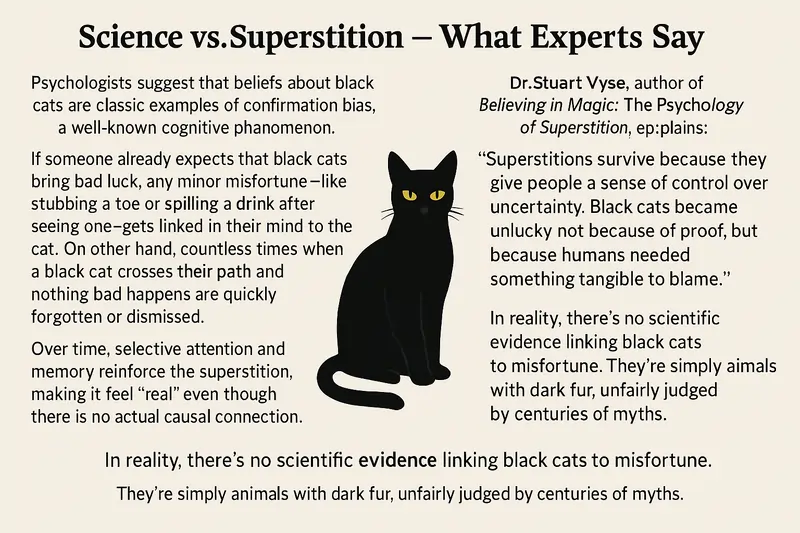
Psychologists suggest that beliefs about black cats are classic examples of confirmation bias, a well-known cognitive phenomenon. If someone already expects that black cats bring bad luck, any minor misfortune—like stubbing a toe or spilling a drink after seeing one—gets linked in their mind to the cat. On the other hand, countless times when a black cat crosses their path and nothing bad happens are quickly forgotten or dismissed. Over time, this selective attention and memory reinforce the superstition, making it feel “real” even though there is no actual causal connection. This is why many superstitions persist across generations: our brains are wired to notice patterns that confirm our expectations while ignoring those that contradict them.
Dr. Stuart Vyse, author of Believing in Magic: The Psychology of Superstition, explains:
“Superstitions survive because they give people a sense of control over uncertainty. Black cats became unlucky not because of proof, but because humans needed something tangible to blame.”
In reality, there’s no scientific evidence linking black cats to misfortune. They’re simply animals with dark fur, unfairly judged by centuries of myths.
Pop Culture and the Black Cat Image
From literature to films, black cats have long been portrayed as both magical and menacing, capturing the imagination of audiences around the world. In classic novels and fairy tales, they often appear as mysterious companions to witches or as symbols of hidden knowledge. In modern movies and television, black cats are sometimes cast as eerie harbingers of danger, adding suspense or a touch of supernatural intrigue. At the same time, some works celebrate their elegance and mystical qualities, showing them as clever, enchanting, or even protective creatures. This dual portrayal reflects how deeply cultural perceptions and storytelling traditions have shaped the way we view black cats—oscillating between fear and fascination.
i have a article that back up this affirmation: The Magic and Mystery of Black Cats. This article explores the symbolic roles of black cats in literature and art, highlighting their association with mystery, magic, and danger. It discusses how black cats have been depicted in various cultural contexts, from Edgar Allan Poe’s story “The Black Cat” to modern portrayals in films like “Hocus Pocus” and “Sabrina the Teenage Witch.”
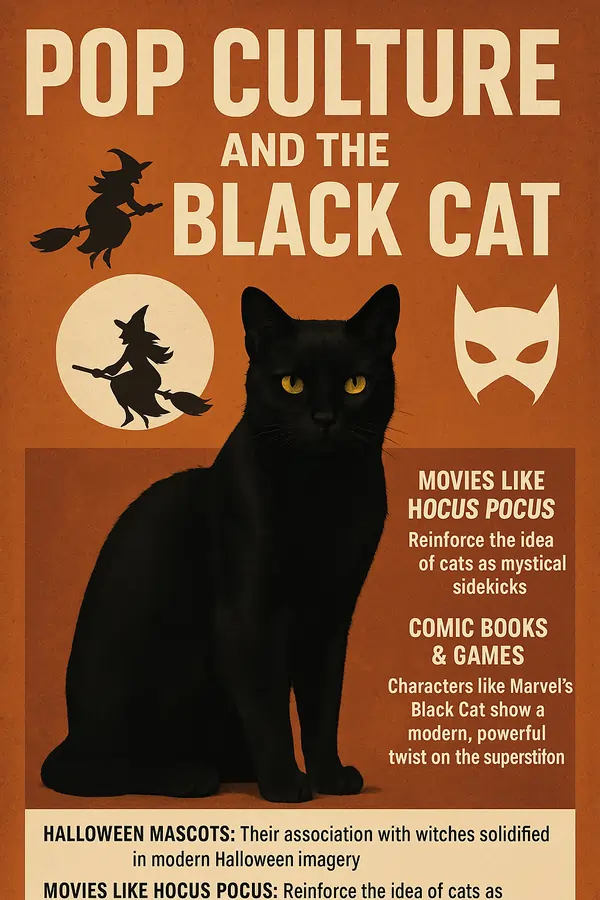
Black cats have become iconic figures across popular culture, appearing in everything from Halloween decorations to blockbuster films and comics. Their longstanding association with witches helped cement them as Halloween mascots, while movies like Hocus Pocus continue to portray them as mystical companions. Even in modern media, characters such as Marvel’s Black Cat give a fresh, empowering spin on the superstition, showing that these animals can be seen as clever, magical, and intriguing rather than simply unlucky.
-
Halloween mascots: Their association with witches solidified in modern Halloween imagery.
-
Movies like Hocus Pocus: Reinforce the idea of cats as mystical sidekicks.
-
Comic books & games: Characters like Marvel’s Black Cat show a modern, powerful twist on the superstition.
But here’s the twist: these depictions often keep the myth alive, even when people don’t consciously believe in it. Media shapes perceptions, which explains why adoption rates for black cats still dip around Halloween in some shelters.
Real-Life Impact—Black Cats in Shelters
One of the saddest outcomes of the superstition is how it affects real cats today. According to the ASPCA, black cats often face lower adoption rates in animal shelters compared to cats of other colors. They tend to be overlooked by potential adopters, sometimes spending weeks or months waiting for a home. In some cases, this “black cat bias” even contributes to higher euthanasia rates, not because of behavior or health, but simply due to their color. It’s a stark reminder of how cultural myths can have real-world consequences, turning an innocent animal into an unintended victim of superstition.
-
The least likely to be adopted from shelters.
-
The most likely to be euthanized.
-
Often overlooked simply because they don’t photograph as easily as lighter-colored cats.
This means superstition isn’t just harmless folklore—it’s costing thousands of cats their lives every year.
Counterarguments—Why People Still Believe
Even with all the evidence, some people still swear by the “bad luck” myth. Here’s why: superstitions are deeply rooted in human psychology. Confirmation bias makes us notice and remember events that seem to support our beliefs, while ignoring countless times when nothing unusual happens. Cultural traditions and stories passed down through generations reinforce these ideas, making them feel familiar and “true.” Add to that the influence of movies, literature, and media that dramatize black cats as mystical or ominous, and it’s easy to see why the myth persists, even in the face of scientific evidence.
-
Cultural Conditioning – Stories passed down for generations are hard to shake.
-
Fear of the Unknown – Darkness and mystery have always triggered human caution.
-
Entertainment Value – Myths are fun to tell, especially around Halloween, even if they’re not true.
But knowing the truth empowers us to challenge these outdated ideas—and protect innocent animals.
The Positive Symbolism of Black Cats
Instead of fearing black cats, we should celebrate what they truly represent: mystery, elegance, and resilience. These animals have long been symbols of independence and intuition, reminding us to embrace the unknown with curiosity rather than superstition. Appreciating black cats for their unique beauty and charm helps us honor their role in folklore and in our lives today.
-
Resilience – Surviving centuries of unfair stigma.
-
Mystery – Their sleek appearance adds elegance and intrigue.
-
Companionship – Like all cats, they bring comfort, affection, and joy to their owners.
Far from being unlucky, black cats are a reminder of how easily myths can cloud judgment—and how rewarding it is to see beyond them.
Why You Should Care (And What To Do Next)
If you’ve ever avoided adopting a black cat—or even just hesitated when one crossed your path—now’s the time to change perspective. Supporting truth over superstition makes a real-world difference.
👉 At 10 Amazing Facts You Didn’t Know, we’re committed to breaking myths, sharing fascinating truths, and giving you insights you won’t find anywhere else. By subscribing today, you’ll unlock:
-
Exclusive in-depth myth-busting articles.
-
Access to our premium members-only library of amazing facts.
-
Ad-free browsing and bonus content.
-
Special behind-the-scenes videos only available to subscribers.
And don’t forget—our YouTube channel is packed with surprising stories just like this one. Click through, watch, and subscribe to be part of our growing community of curious minds.
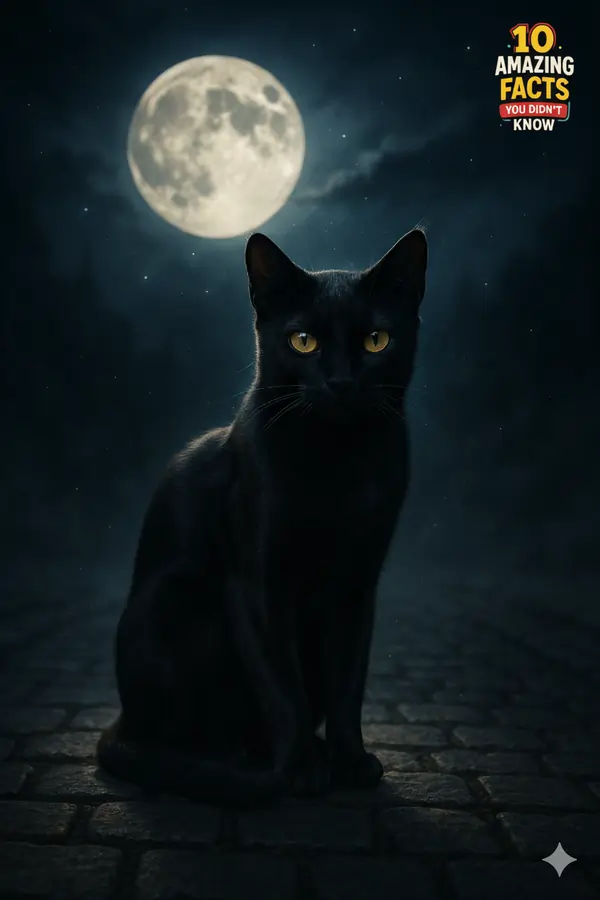
FAQs: Are Black Cats Bad Luck?
Q1: Are black cats unlucky everywhere in the world?
No. While Europe historically associated black cats with witches and bad luck, countries like Japan, Scotland, and Ireland consider them symbols of good fortune.
Q2: Why do people still believe black cats are bad luck?
Superstition thrives because of cultural traditions, fear of the unknown, and confirmation bias. People notice when “bad” follows a black cat sighting but forget when nothing happens.
Q3: Do black cats get adopted less often?
Yes. Studies from the ASPCA confirm that black cats face lower adoption rates and higher euthanasia rates than other cats.
Q4: What does it mean if a black cat crosses your path?
The meaning varies by culture. In the U.S. and parts of Europe, it’s seen as bad luck. In Japan and the U.K., it can mean prosperity or love is coming your way.
Q5: Are there benefits to owning a black cat?
Absolutely. Black cats are just as loving, playful, and loyal as any other pet. They also symbolize resilience and mystery, making them extra special companions.
Conclusion: The Verdict on Black Cats
So, are black cats bad luck? The answer is clear: No. They are victims of centuries-old myths, not bearers of misfortune. In reality, they’re symbols of love, resilience, and mystery.
If you’ve made it this far, you’re exactly the kind of curious thinker we love here at 10 Amazing Facts You Didn’t Know. Don’t stop at just one article—subscribe today to unlock even more fascinating truths that will challenge the way you see the world. And while you’re at it, head over to our YouTube channel for videos that bring these stories to life.
The next time a black cat crosses your path, don’t fear it—consider it lucky.