

Can Cats Really See in the Dark?
The Science Behind Feline Night Vision
The Cats can see better than a human in the Dark, thats a Yes, but can they see in complete Darkness thats a No. They have better vision in little light but if its all dark they cant see same as us. Their eyes capture better the minimal light, and this is an adaptation for one thing only, hunting and survival. Cats are often described as mysterious, stealthy, and perfectly adapted to the darkness. Anyone who has watched a cat confidently move through a dark room or leap effortlessly at night has probably wondered: can cats really see in the dark? While it may seem like cats possess supernatural vision, the truth is rooted in biology, evolution, and advanced sensory adaptation.
Although cats cannot see in complete darkness, they are exceptionally skilled at seeing in low-light environments. Their eyes are biologically engineered to capture and amplify minimal light, allowing them to navigate dim spaces far better than humans. In this in-depth guide, we’ll explain exactly how cats see in the dark, why their vision is superior in low light, common myths about feline night vision, and how cats use other senses when vision alone isn’t enough.
Can Cats See in Complete Darkness?
The short answer is no. Cats cannot see in complete darkness where there is absolutely no light present. Vision requires at least some light to function. However, cats need far less light than humans to see clearly. Research shows that cats can see using approximately one-sixth the amount of light required by human eyes. This allows them to function extremely well at night, during dusk, dawn, or in poorly lit indoor environments.
This distinction is important because many people mistakenly believe cats have true night vision. In reality, cats excel in low-light conditions, not total darkness. Cats hunts at night they hunt and protect at that time thats why they are so active in those hours so yes they need a really good vision when the light is not so good. Its a predator thing.
✅ Expert Quote (Vet + Ophthalmology Source)
Cats can see very well in low-light conditions because their eyes contain more rod photoreceptors and a reflective layer called the tapetum lucidum, which helps maximize available light and improves vision in dim environments. However, they still require some light to see and cannot see in total darkness.”
— Dr. Kristin Fischer, DAVCO, Veterinary Ophthalmologist at Animal Eye Country of the Lowcountryhttps://www.chewy.com/education/cat/general/can-cats-see-in-the-dark
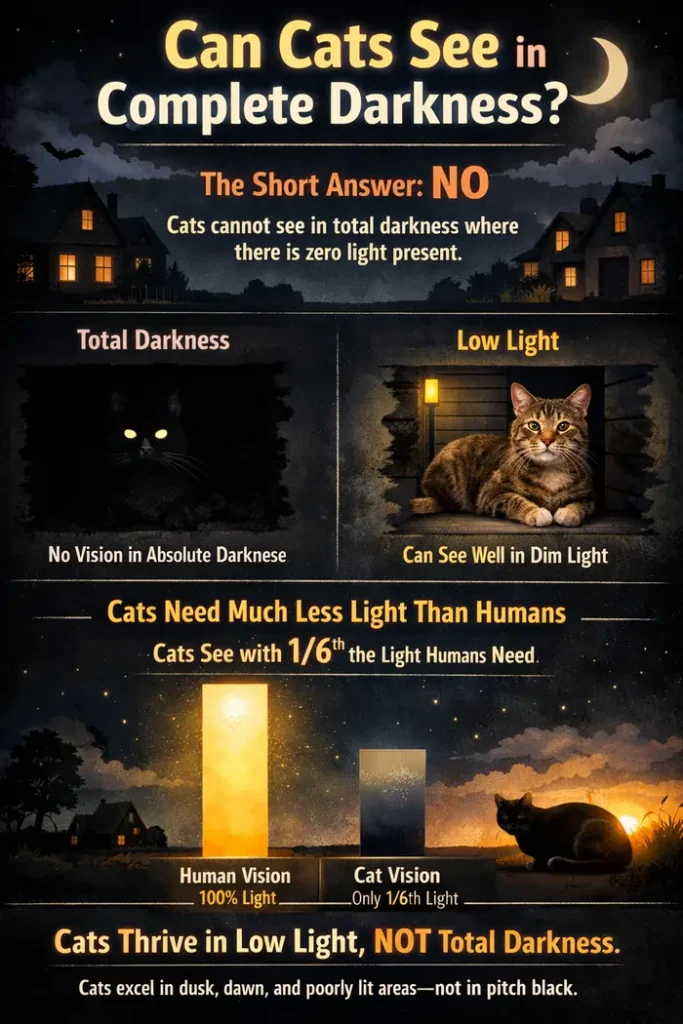
Limitations of Cat Night Vision
Although cats are exceptionally skilled at seeing in low-light environments, their vision has important limitations that are often misunderstood. Recognizing these limitations helps explain why cats rely on multiple senses rather than eyesight alone when navigating darkness.
Cats Cannot See in Total Darkness
Despite popular belief, cats still require at least some ambient light to see. In environments with zero light, visual information cannot be processed by the eye, regardless of how well adapted it may be. This is why cats depend on memory, hearing, and whisker sensitivity when moving in pitch-black spaces.
Reduced Color Perception in Low Light
As lighting conditions decrease, a cat’s ability to perceive color diminishes significantly. In low-light environments, cats primarily see shades of gray and muted tones, prioritizing motion detection over color accuracy. This tradeoff enhances hunting ability but limits visual detail.
Bright Light Sensitivity
Because feline eyes are optimized to capture minimal light, sudden exposure to bright lighting can be uncomfortable. Cats may squint or avoid direct light sources, particularly in daylight conditions or brightly lit rooms.
Age and Health Can Affect Night Vision
Senior cats and cats with underlying eye conditions may experience reduced night vision. Cataracts, glaucoma, retinal degeneration, and infections can interfere with the eye’s ability to process low-light information, sometimes causing hesitation or disorientation in dark environments.
Cat Night Vision: Key Limitations at a Glance
This infographic summarizes the main limitations of cat night vision, backed by scientific data, to help you understand how cats see in low-light conditions.
Minimum Light Required
Cats: Can see in ~1/6th the light humans need
Color Perception
In low light, cats see mostly gray or muted tones, while humans can see full color.
Motion Detection
Cats have 6–8× more rod cells than humans, enhancing motion detection in darkness.
Bright Light Sensitivity
Sudden bright light can make cats squint or avoid light, unlike humans who are comfortable.
😎 😾
Age Impact
Older cats (7–10+ years) may have reduced night vision due to retinal degeneration or cataracts.
Human Vision – Cat Vision Decline
Health Impact
Eye conditions such as cataracts, glaucoma, or retinal degeneration reduce night vision.
Sources: Dr. Kristin Fischer, DAVCO Veterinary Ophthalmologist; Chewy.com – “Can Cats See in the Dark?”
How Cat Eyes Are Designed for Low-Light Vision
A cat’s ability to see in the dark comes from several unique anatomical features that work together to maximize light sensitivity and motion detection.
The Tapetum Lucidum: Nature’s Light Amplifier
One of the most important features of feline vision is the tapetum lucidum, a reflective layer of tissue located behind the retina. This structure reflects incoming light back through the retina, effectively giving light-sensitive cells a second chance to process visual information.
This is the reason cats’ eyes appear to glow when light hits them in darkness. The tapetum lucidum significantly enhances low-light visibility, allowing cats to make the most of minimal illumination.
While this adaptation improves night vision, it slightly reduces sharpness and clarity during daylight, which is why cats may squint or avoid bright light.
Rod Cells vs. Cone Cells
The retina contains two types of photoreceptor cells: rods and cones.
- Rod cells detect light and motion
- Cone cells detect color and fine detail
Cats have a much higher concentration of rod cells than humans. This allows them to detect movement and shapes in low light far more effectively. However, they have fewer cone cells, meaning their color vision is more limited.
As a result, cats prioritize motion detection over color accuracy—an advantage for hunting and survival.
How Much Better Is a Cat’s Night Vision Compared to Humans?
Compared to humans, cats are extraordinarily well-equipped for nighttime activity.
| Vision Feature | Cats | Humans |
|---|---|---|
| Minimum light required | Very low | Moderate |
| Motion detection | Excellent | Average |
| Color perception | Limited | Strong |
| Field of vision | Wider | Narrower |
Cats evolved as crepuscular hunters, meaning they are most active at dawn and dusk. Their vision is optimized for these lighting conditions, allowing them to stalk prey efficiently when visibility is low.
Why Cats Still Struggle in Pitch Darkness
Despite their impressive low-light vision, cats cannot rely on eyesight alone when there is no light at all. In pitch darkness, cats depend heavily on other senses to move safely.
When visual input is unavailable, cats use:
- Whiskers to detect air currents and nearby objects
- Exceptional hearing to locate movement and sounds
- Spatial memory to navigate familiar environments
This multi-sensory approach allows cats to appear confident even when visibility is extremely poor.
Do All Cats Have the Same Night Vision?
While all domestic cats share similar visual traits, night vision can vary slightly depending on age, health, and environmental factors.
Age and Vision
Kittens generally have excellent night vision, which may decline slightly as cats age. Senior cats can experience reduced visual clarity due to normal aging or eye conditions.
Health Conditions
Eye infections, cataracts, glaucoma, or retinal disorders can significantly impair a cat’s ability to see in low light.
Breed Differences
Breed has minimal impact on night vision, though eye size and skull shape may create slight variations.
Common Myths About Cats Seeing in the Dark
- Myth: Cats can see in total darknessFact: Cats need at least some light to see.
- Myth: Cats see better at night than during the dayFact: Cats are adapted for low light, not bright sunlight.
- Myth: Glowing eyes mean cats emit lightFact: The glow comes from reflected light, not emission.
How Cats Use Other Senses at Night
Vision is only one part of a cat’s nighttime toolkit. Cats are sensory specialists.
Whiskers (Vibrissae)
Highly sensitive whiskers detect changes in air pressure, helping cats judge distances and avoid obstacles.
Hearing
Cats can hear frequencies far beyond human capability, allowing them to locate prey or movement even in darkness.
Memory and Mapping
Cats memorize their surroundings. This mental mapping allows them to move confidently through familiar spaces even without visual cues.
Should Cats Have Night Lights Indoors?
In most cases, cats do not need night lights. Their eyes adapt quickly to low light, and ambient light from windows or electronics is usually sufficient.
However, senior cats or cats with vision impairments may benefit from soft, consistent lighting to prevent disorientation.
Frequently Asked Questions About Cat Night Vision
Can cats see color at night?
Cats can see limited colors, primarily blues and greens, but color perception decreases significantly in low light.
Do cats’ eyes get damaged by bright light?
Bright light can be uncomfortable but generally does not damage healthy cat eyes.
Why do cats’ eyes glow in photographs?
The glow is caused by light reflecting off the tapetum lucidum.
Can cats recognize people in the dark?
Cats rely more on scent and sound than sight to recognize familiar people in low-light conditions.
How Cats See in the Dark
Several biological adaptations give cats their legendary night vision:
1. Oversized Pupils
When light is scarce, your cat’s pupils expand to enormous circles, almost covering the entire visible eye. This allows them to capture every photon of light available—like turning their eyes into natural wide-angle lenses.
2. The Tapetum Lucidum: Nature’s Mirror
One of the coolest features of feline vision is the tapetum lucidum, a reflective layer of cells behind the retina. It works like a built-in night-vision enhancer by reflecting light back through the eye, giving the retina a second chance to capture it. This is also why cat eyes glow eerily in the dark when a flashlight or car beam hits them.
3. More Rod Cells, Fewer Cone Cells
Cats’ eyes are packed with rod cells—specialized for detecting light and motion—rather than cone cells, which are responsible for color vision. This means cats see better at night but sacrifice sharp color detail. To them, the world is muted in shades of blue and gray but alive with movement.
Cats vs. Humans: Who Wins the Night Vision Contest?
If a human could see a candle flame at 100 feet, a cat could spot the same flame from more than 300 feet away. Impressive, right?
But there’s a trade-off. Humans win in daylight, seeing a broader range of colors and sharper details. Cats, however, dominate in low light, which explains why they’re masters of nighttime hunting.
Do Cats See in Total Darkness?
Here’s where myth meets reality:
-
No, cats cannot see in pitch-black conditions where no light exists.
-
Yes, cats can see far better than humans in dim or twilight conditions, such as moonlight, starlight, or even light leaking from under a door.
Think of it this way: while you’d trip over the furniture at midnight, your cat would leap gracefully onto the couch without missing a beat.
Why Do Cats Need Superior Night Vision?
The answer lies in their ancestry. Cats are crepuscular hunters, meaning they are most active during dawn and dusk. These are the hours when rodents and small prey are most active, and having superior low-light vision gave wild cats an evolutionary edge.
Even your spoiled indoor tabby still carries this biological advantage. That’s why your cat loves sprinting through the hallway at 3 a.m.—their instincts tell them it’s prime hunting time!
Common Myths About Cats Seeing in Darkness
-
Myth: Cats see perfectly in pitch black.
Reality: They need at least some light to see. -
Myth: Cats see the world in full color like humans.
Reality: They see mostly shades of blue and gray, with limited ability to detect reds and greens. -
Myth: Cats’ glowing eyes are supernatural.
Reality: It’s a reflection caused by the tapetum lucidum.
Why This Matters for Cat Owners
Understanding how your cat sees at night helps you:
-
Appreciate why your cat is most playful at dawn and dusk.
-
Realize why they sometimes “attack shadows” or dart at things you can’t see—they’re spotting movements invisible to your eyes.
-
Create safer environments by avoiding obstacles or dangerous objects where your cat loves to roam in dim light.
👉 Don’t miss our YouTube channel, where we share visually stunning fact videos designed to blow your mind.
Remember—knowledge isn’t just power, it’s fun. And your next “aha!” moment is only one subscription away.
FAQs About Cats Seeing in Darkness
1. Can cats see in complete darkness?
No. Cats need at least a small amount of light, such as moonlight or starlight, to see.
2. Do cats have better vision than humans at night?
Yes. Cats’ eyes are about six times more sensitive to low light compared to human eyes.
3. Why do cat eyes glow in the dark?
Because of the tapetum lucidum, a reflective layer behind the retina that bounces light back and enhances night vision.
4. Can cats see colors?
Cats see some colors, mainly shades of blue and gray. They cannot perceive reds and greens as humans do.
5. Why do cats run around at night?
Their instincts as crepuscular hunters drive them to be most active during low-light hours like dawn and dusk.
Conclusion: Can Cats See in the Dark?
Cats cannot see in total darkness, but they are remarkably efficient at navigating low-light environments. Their eyes are biologically adapted to amplify minimal light, detect motion, and work alongside heightened hearing, whiskers, and memory.
This combination of senses explains why cats appear so confident at night. Their vision may not be magical—but it is one of nature’s most impressive adaptations.